
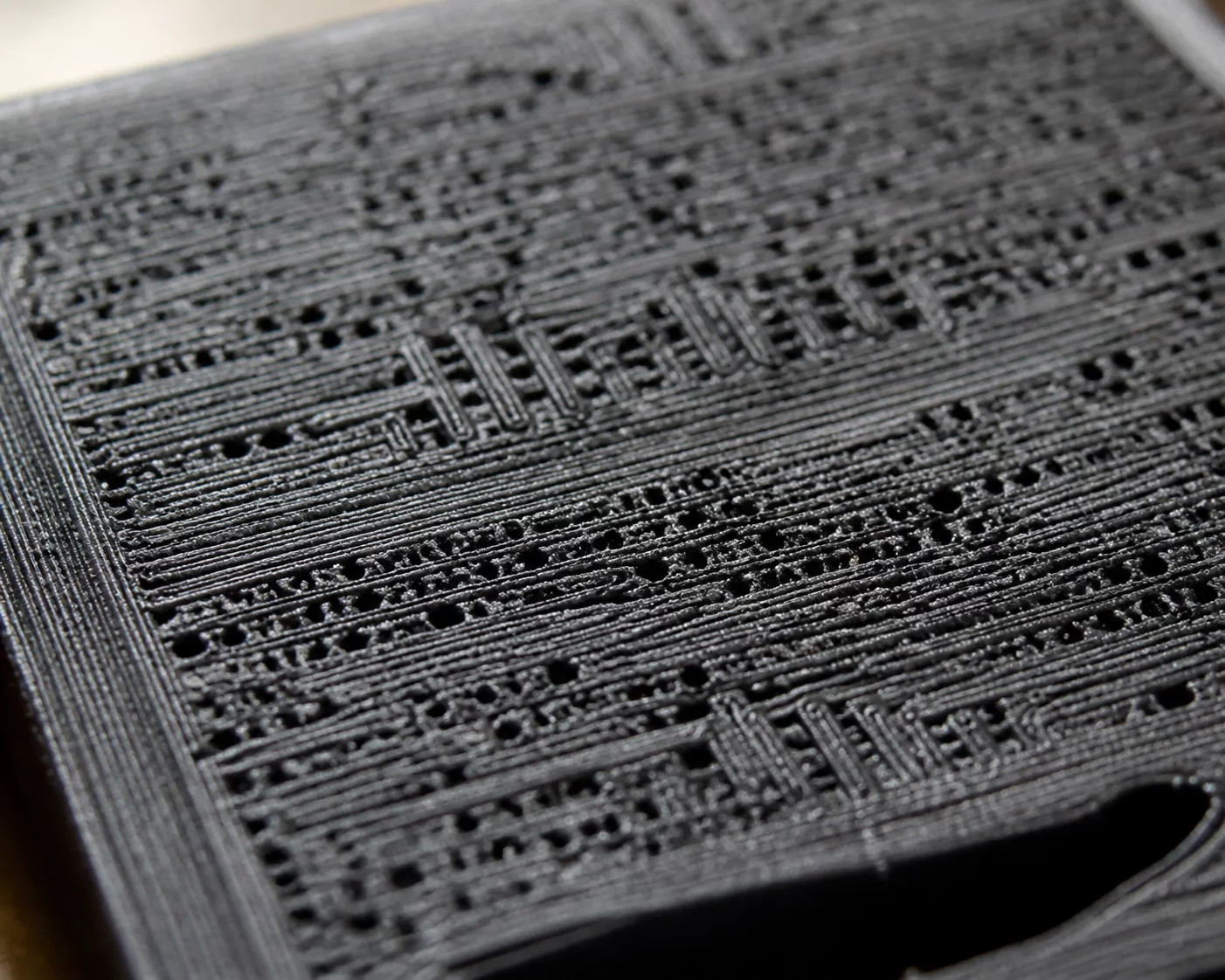
Under-extrusion manifests across structural surfaces as missing tracks, spongy perimeter layers, and micro-voids between toolpaths. While catastrophic extrusion failure results in complete air printing, subtle under-extrusion artifacts degrade interlayer shear strength and leave jagged micropores along planar surfaces. These discontinuities compromise tensile stability and render fluid-tight assemblies completely non-functional.
Root Cause Topology & Mechanical Origins
Volumetric flow bottlenecks occur when the extruder motor cannot push molten polymer through the heatblock at the commanded feed rate. Partial heat creep softens filament premature to the melt zone, inflating mechanical resistance against the drive gears. Secondary factors include uncalibrated flow ratios in slicing profiles, worn extruder tooth geometry, and degraded PTFE throat liners creating backpressure spikes.
Microscopic evaluation demonstrates that under-extrusion often mimics random delamination. However, tracking the feed path indicates that high-speed travel retract cycles deplete nozzle pressure. Without pressure advance tuning, the nozzle starts each new line starved of molten material, leaving telltale hollow notches near outer perimeter transitions.
Systematic Calibration & Recovery Directives
- Perform atomic cold-pull procedures at 90C to extract carbonized debris from the melt chamber orifice.
- Recalibrate flow ratio multiplier within slicer filament profiles using dual-wall hollow cube micrometer measurements.
- Inspect extruder idler spring tension and replace worn knurled drive gears to prevent intermittent filament slippage.
Standardizing print temperatures to match high-speed volumetric output guarantees steady internal melt dynamics. Ensuring unimpeded spool unwinding and configuring dynamic flow compensation completely eliminates starvation marks across both rapid infill sweeps and fine cosmetic perimeters.
Forensic Discussion & Logs
The spatial vector assay determined an instantaneous 6.8% volumetric drop across dense top fill layers when hotend temperatures sagged below 215C during acceleration. Raising the heater duty cycle and increasing the flow ratio to 1.03 permanently restored perimeter wall density.
Append Telemetry Observation