
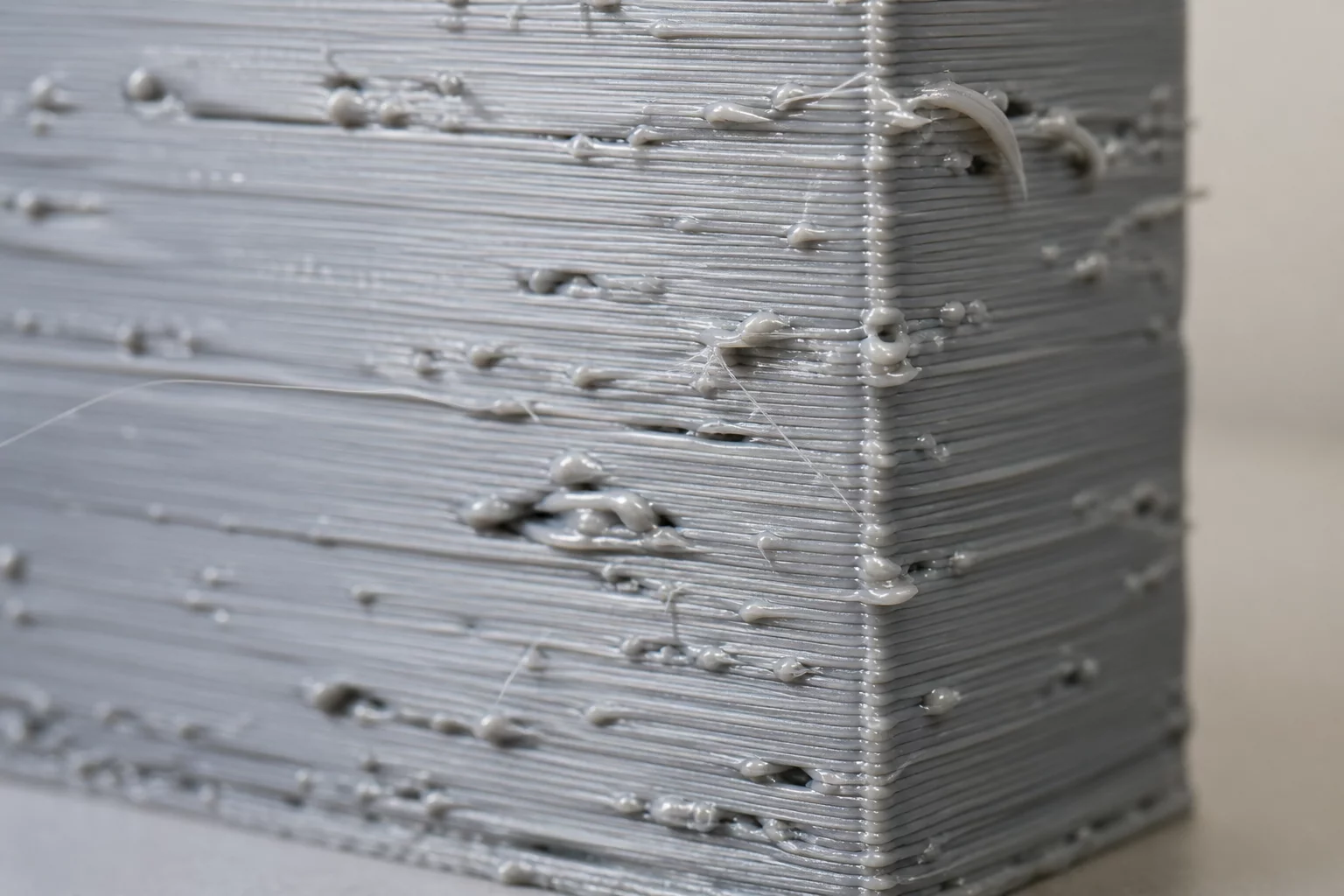
Surface nodules and sporadic plastic outgrowths emerge when molten polymer exceeds nominal layer volume. These localized protrusions distort intended exterior geometry, degrade assembly mating interfaces, and produce rough tactile blemishes across flat and contoured surfaces alike.
Root Cause Topology & Mechanical Origins
Molten polymer pressure inside the melt zone remains elevated during acceleration transitions, pushing residual material through the orifice past nominal toolpath endpoints. Slicer extrusion multipliers set above physical feedstock density thresholds exacerbate this effect, leaving behind visible teardrops and hemispherical bumps.
Uncalibrated pressure advance parameters also fail to bleed melt-zone compression before direction changes. The hotend continues to deposit excessive material during deceleration phases, creating thick deposits near sharp corners and perimeter-to-infill boundaries.
Systematic Calibration & Recovery Directives
- Perform single-wall hollow cube flow calibrations and adjust extrusion multiplier downward in increments of 0.02.
- Calibrate pressure advance and linear advance values to decompress the melt chamber prior to deceleration maneuvers.
- Lower printing temperature by 5°C to 10°C to elevate melt viscosity and curb involuntary nozzle dripping.
Applying structured flow rate verification protocols ensures consistent filament volumetric feed rates across fluctuating motion speeds, eliminating irregular perimeter blobs without triggering under-extrusion voids.
Forensic Discussion & Logs
Append Telemetry Observation