
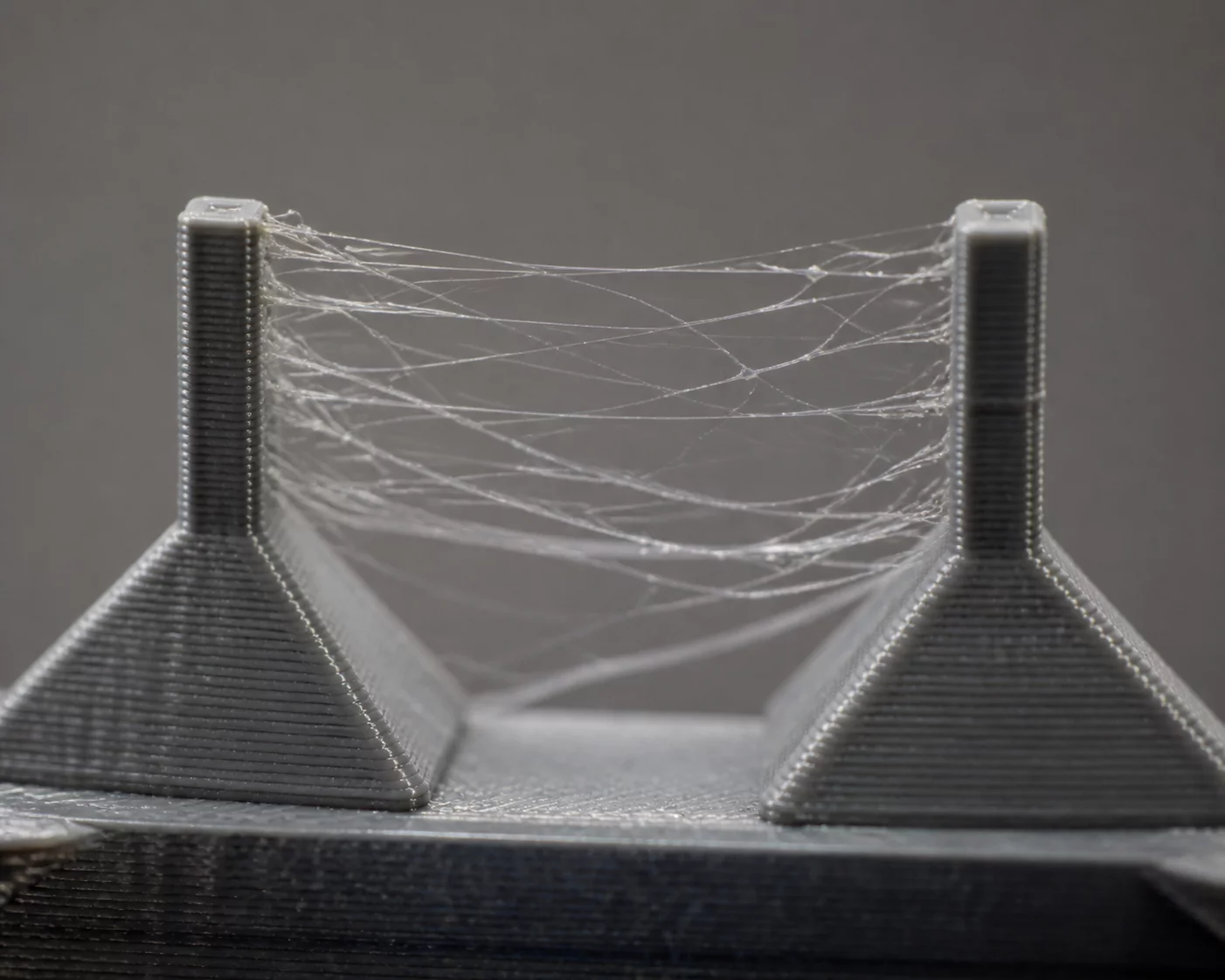
Stringing manifests as thin, spiderweb-like filaments suspended between unconnected pillars or open gaps on a finished 3D print. When the extruder travels across empty air without depositing material, residual melt pool pressure inside the nozzle cavity causes liquified polymer to bleed through the orifice. Even minor thermal or volumetric mismatches transform clean travel clearances into cluttered webs of degraded filament hairs.
Root Cause Topology & Mechanical Origins
The primary driver behind unwanted oozing involves heat creep, high melt zone temperatures, and inadequate retraction distance. Molten filament expands slightly within the thermal break, creating positive hydrostatic pressure. When the extruder motor stops pushing filament during a travel command, this internal pressure forces molten plastic through the nozzle tip unless an immediate, calibrated negative-pressure vacuum retracts the melt stream. Additionally, moisture absorption in hygroscopic filaments like PETG, PLA, and Nylon lowers melt viscosity, leading to steam cavitation that forcefully expels stringing micro-droplets.
Addressing oozing requires synchronizing thermal gradients with kinematics. Excessive nozzle temperatures degrade polymer melt viscosity, making liquid filament far too fluid to hold position during rapid carriage repositioning. Travel acceleration must also be maximized to shorten the dwell time of the hot nozzle over open boundaries. Setting proper wipe moves and combing directives confines travel paths inside existing infill perimeters, eliminating visible external filament strings altogether.
Systematic Calibration & Recovery Directives
- Lower nozzle hotend temperature by 5°C to 10°C increments until the melt pool retains sufficient surface tension during idle carriage travel moves.
- Tune retraction distance (0.8–1.4mm for direct drive, 4.0–6.5mm for Bowden setups) at a retraction speed of 35–45mm/s.
- Enable wipe-while-retracting (0.4mm) and configure travel speed to a minimum of 250mm/s to snap filament strings instantly at perimeter boundaries.
Systematically calibrating retraction parameters alongside filament drying resolves over 95% of all travel oozing artifacts, ensuring sharp dimensional edges and immaculate surface finish across complex open geometries.
Forensic Discussion & Logs
Append Telemetry Observation