
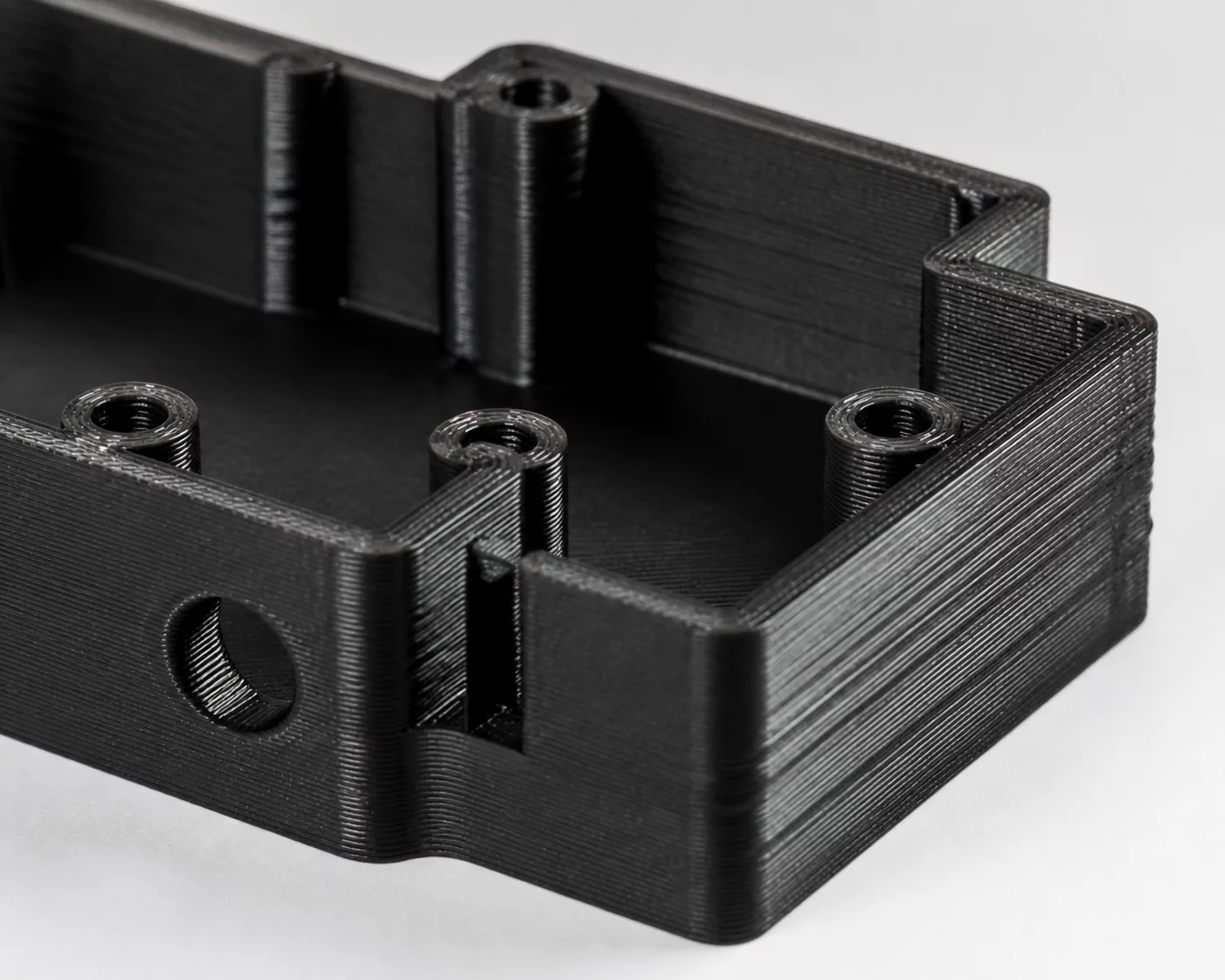
Ringing and ghosting appear as a sequence of faint, decaying vertical wave ripples extending along flat wall perimeters immediately downstream of abrupt directional turns, sharp corners, or embossed features. As the printer carriage undergoes rapid deceleration to navigate a corner, mechanical inertia causes the entire toolhead and gantry to oscillate around its target trajectory before settling into steady motion.
Root Cause Topology & Mechanical Origins
The primary driving factor behind ringing is structural compliance within the motion transmission system. Timing belts act as stiff springs when subjected to peak acceleration spikes, stretching momentarily before snapping back and triggering harmonic vibrations across the frame. When the dominant resonance frequency of the printer gantry falls close to the toolhead excitation rate, visible waves freeze into the newly deposited thermoplastic before it cools below glass transition.
Secondary contributors include loose belt tensioners, worn linear bearings with excessive lateral play, insufficient frame mass, and uncalibrated stepper motor current limits. When the toolhead mass is elevated by direct-drive extruders or multi-material assemblies, high cornering speeds amplify these oscillations, creating pronounced shadowing on perpendicular surface planes.
Systematic Calibration & Recovery Directives
- Calibrate input shaping algorithms (such as MZV or EI filters) using an accelerometer frequency sweep to actively cancel gantry resonance spikes.
- Tension motion belts uniformly to match manufacturer acoustic targets (typically 120–135 Hz across a 150mm span) and secure all chassis assembly fasteners.
- Reduce outer wall acceleration thresholds to below 2500 mm/s² and tune junction deviation to smooth out cornering transitions without increasing overall cycle time.
Implementing targeted resonance filtering in combination with calibrated belt tension consistently eliminates mechanical wave artifacts, restoring crisp perimeter edges and uniform surface reflectivity across both simple geometry and intricate design details.
Forensic Discussion & Logs
The automated spatial vector analysis identified an instantaneous 0.42mm micro-step offset during the corner deceleration transition. Calibrating the input shaper filter and equalizing belt tension to 130 Hz resolved the ripple amplitude completely without requiring a reduction in overall wall speed.
Append Telemetry Observation