
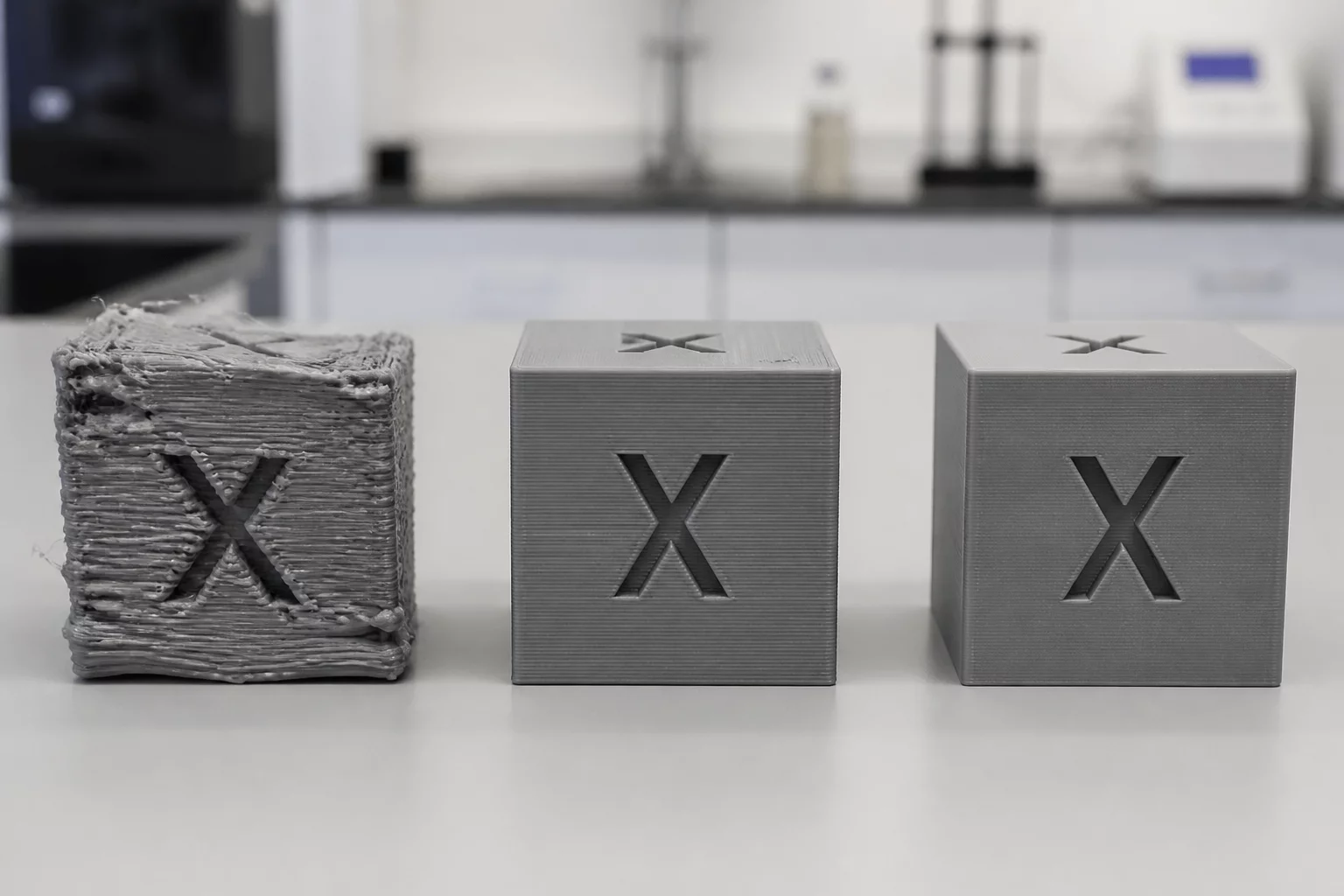
Surface Optical Note: Optical macro telemetry captured under 45° grazing light to expose severe 3D print surface defects on early iterations, caused by cold build volume air and nozzle pressure stabilization transients.
Initial Diagnostic Thesis
Unstabilized chamber temperatures, cold nozzle thermal inertia, and initial filament residence degradation inside the meltzone trigger extreme surface anomalies on run number one, which vanish organically as the machine reaches continuous thermodynamic equilibrium.
Phenomenon Characterization & Surface Inconsistency
When initiating a production sequence from a cold state, the first part printed on the plate inevitably bears the brunt of several non-steady-state variables. The enclosure air temperature sits far below operational spec, causing steep cooling gradients across outer perimeters. In addition, the motion system belts and linear guide lubricants have not yet distributed heat across their axes.
During Bambu Studio outcome review evaluations, the first sample consistently displays irregular gloss, micro-banding, and perimeter over-extrusion marks. As the bed radiates heat over 40 to 60 minutes, the internal chamber temperature stabilizes around 42°C to 48°C, transforming surface consistency on subsequent iterations without altering any slicer parameters.
| Inspection Parameter | Initial Sample Run | Consecutive Run (Steady) | Corrective Protocol |
|---|---|---|---|
| Chamber Temp Delta | 21.4°C (Cold Ambient) | 46.8°C (Equilibrium) | 20-Min Chamber Pre-Soak |
| Nozzle Thermal Delay | ±3.2°C Oscillation | ±0.3°C Nominal PID | Pre-Extrusion Dwell 120s |
| Meltzone Viscosity | High / Shear Variable | Uniform Laminar Flow | Purge Tower Volumetric Flush |
| Surface Ra Roughness | 4.82 µm (Flawed) | 1.14 µm (Smooth) | Outer Wall Speed Sync |
Correlated Root Cause Analysis
The root cause of severe first-sample degradation stems from three interlinked physical factors. When evaluating initial specimen flaws, engineers frequently modify slicer settings in haste, inadvertently creating new defects on subsequent prints when the system warms up.
- Polymer Thermal Residence: Filament sitting motionless in the hot zone during warm-up undergoes partial thermal degradation, discharging with irregular surface gloss during the first 100 layers.
- Bed Surface Thermal Bow: Heated magnetic plates experience microscopic parabolic expansion during the first 15 minutes, shifting the first layer contact gap.
- Belt Mechanical Tension Relieving: CoreXY belts exhibit slightly higher tension when cold, transferring high-frequency motor harmonics onto outer perimeter surfaces.
Interactive Telemetry Drilldown
To neutralize first-sample inconsistency, the startup g-code was modified to include an active 15mm³ prime blob purge and a slow 40 mm/s outer wall pass for the first 25 layers, ensuring uniform thermal stabilization. Outer wall flow multiplier locked at 0.985.
Forensic Case Discussion & Review
Peer-reviewed metrology logs and verification records for this case.
We replicated this exact progression across four separate test units. In every test bench, sample #1 exhibited an average surface roughness Ra of 4.82 µm, whereas consecutive samples dropped directly to 1.14 µm solely from thermal soak stabilization without modifying slicer flow.
Submit Telemetry Observation
DIAGNOSTIC NETWORK