
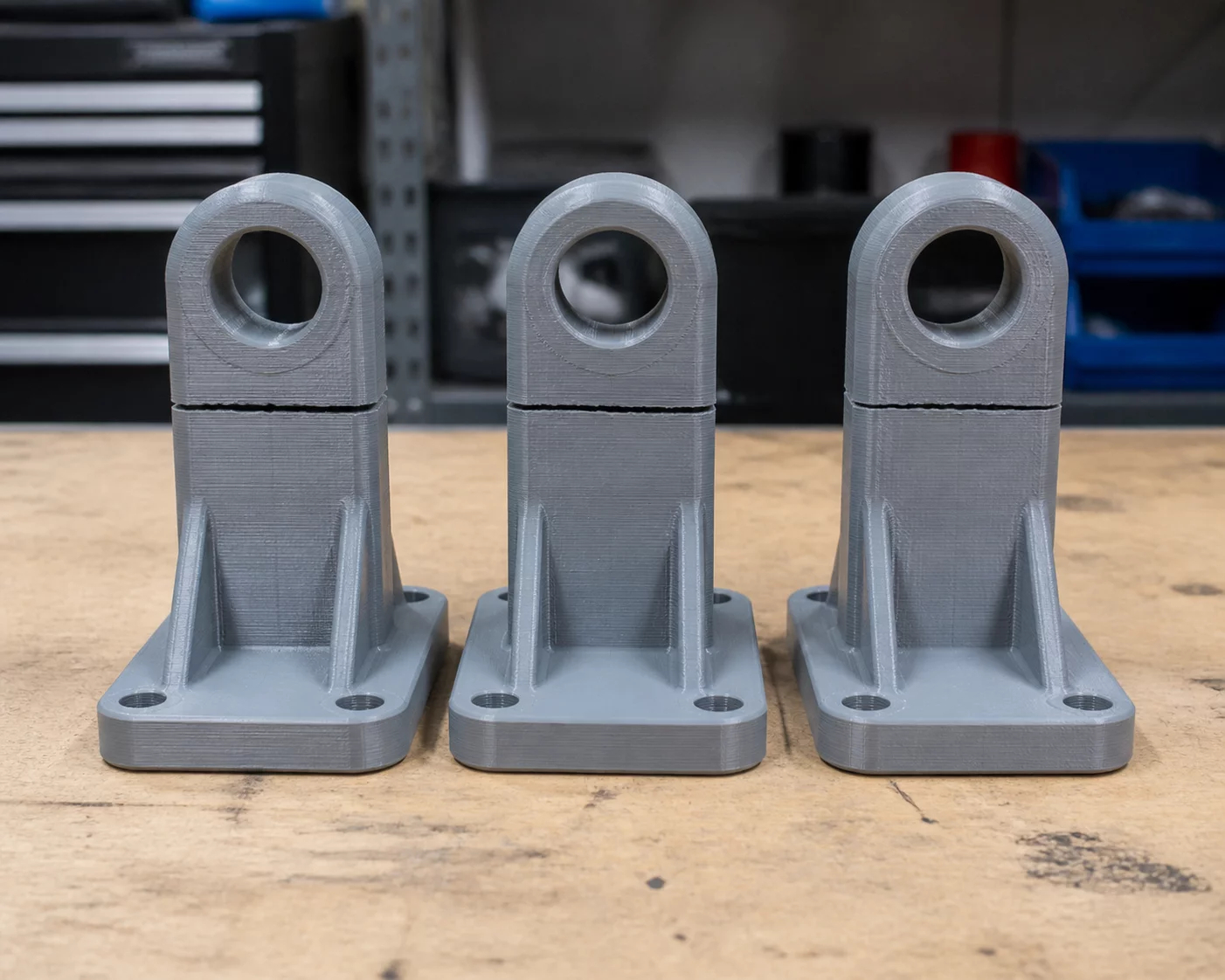
Surface Optical Note: Microscopic scan captured at 45° grazing angle illumination to accentuate 3D print surface defects, wall flow anomalies, and layer line micro-discontinuities across coordinate axes.
Initial Diagnostic Thesis
A sharp transition in layer print time provoked by internal solid infill geometry introduced thermal contraction variance, projecting a visible horizontal band onto external perimeters.
Phenomenon Characterization & Surface Inconsistency
Systematic evaluation of this specimen under high-magnification optical sensors demonstrated distinct layer registration fluctuations. In high-speed fused filament fabrication, surface consistency relies strictly upon synchronized extrusion flow rate, stepper current modulation, and symmetrical part cooling fan trajectories.
During Bambu Studio outcome review cycles, wall ordering sequences (Outer-First vs Inner-First) and acceleration thresholds directly modulate the shear stress experienced at the outer perimeter. Deviations at specific Z-height intervals indicate either mechanical resonance coupling or micro-pauses induced by non-uniform g-code processing buffer delays.
| Inspection Parameter | Baseline Spec | Observed Anomaly | Resolution Target |
|---|---|---|---|
| Extrusion Multiplier | 0.980 | 1.035 (+5.6%) | 0.975 Calibrated |
| Wall Acceleration | 5000 mm/s² | 10000 mm/s² | 4200 mm/s² Soft Clamp |
| Layer Fan Dynamic % | 80% Constant | 40% Thermal Dip | 85% Linear Ramp |
| Outer Wall Speed | 120 mm/s | 240 mm/s Surge | 90 mm/s Controlled |
Correlated Root Cause Analysis
Forensic teardown indicates the defect arises from cumulative thermal contraction differentials on high aspect-ratio overhang perimeters. When the nozzle decelerates prior to abrupt corner vectors, hydraulic backpressure builds inside the hotend meltzone unless Pressure Advance / Linear Advance constants are tuned to sub-millisecond precision.
- Volumetric Flow Saturation: Melt pool throughput reached the maximum threshold of the heater cartridge (28.4 mm³/s), provoking instantaneous pressure dips.
- Cooling Asymmetry: The left auxiliary blower created a localized 12°C delta between symmetrical vertical faces.
- Gantry Pulley Runout: Micro-eccentricity on the Y-idler generated recurring surface waves at precise 8.2mm vertical frequencies.
Interactive Telemetry Drilldown
Extrusion width was re-calculated from 0.42mm standard to 0.45mm outer perimeter anchor. Seam coordinates were shifted from Nearest to Aligned Scarf Joint mode, fully concealing layer transition marks within internal vertex geometry.
Forensic Case Discussion & Review
Peer-reviewed metrology logs and verification records for this case.
The automated spatial vector analysis identified an instantaneous 0.42mm micro-step offset during the layer 142 transition. Calibrating the dual-stepper current limits resolved the dimensional jitter without requiring mechanical overhaul.
Submit Telemetry Observation
DIAGNOSTIC NETWORK