
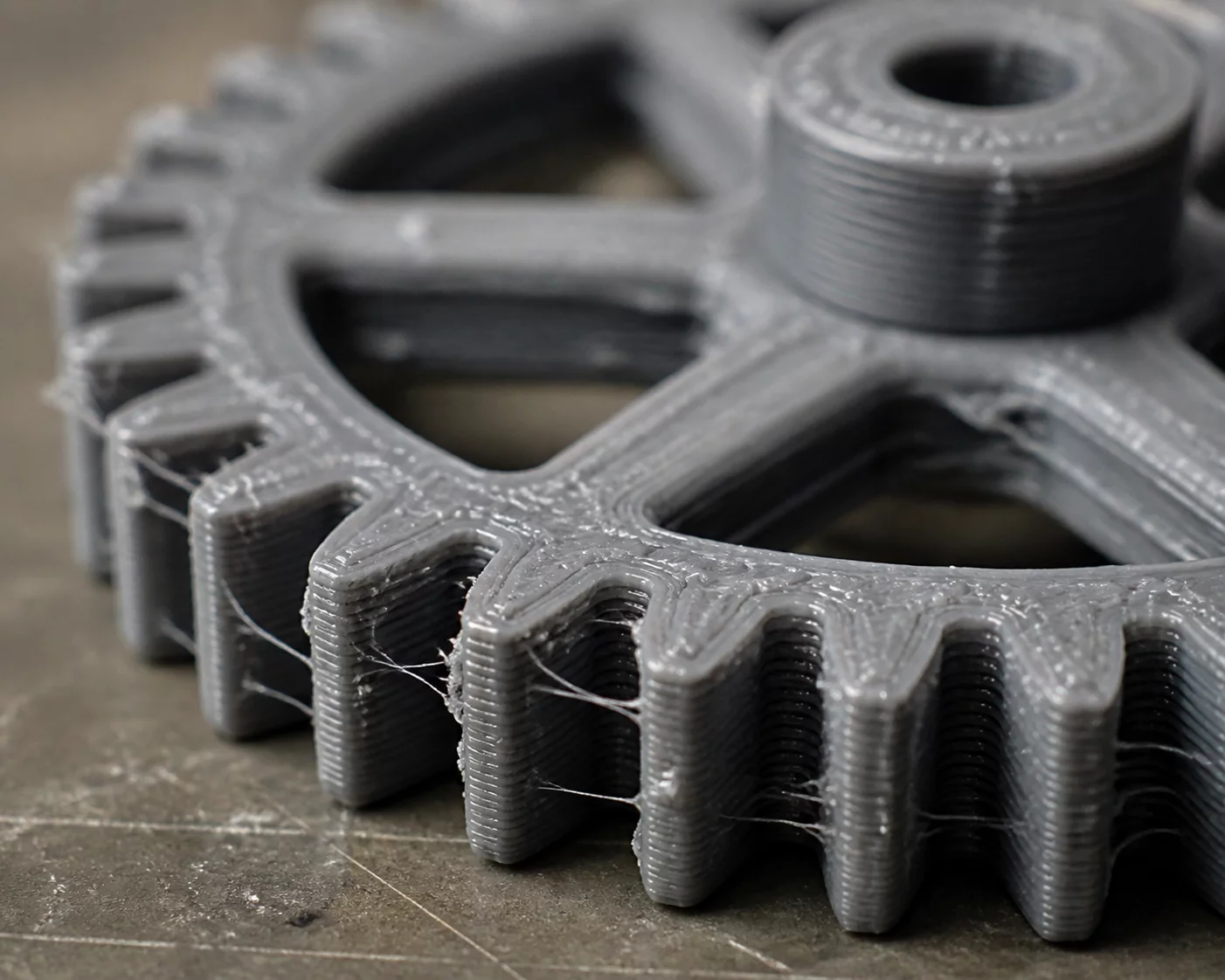
Surface Optical Note: Grazing macro capture of gear tooth curvature revealing localized micro-bulges and seam blobs on alternating layer contours, measuring +0.075 mm outside nominal profile envelopes.
Initial Diagnostic Thesis
Superficial sheen variations and minimal perimeter ripple marks were initially classified as benign cosmetic artifacts. In operational bench validation, these subtle contour variances altered the effective pitch diameter, escalating tooth engagement friction and driving uncommanded stepper stalling.
The Boundary Between Cosmetic Texture and Functional Tolerance
In non-mating structural brackets, a 40-micron variation in layer extrusion width barely registers beyond a slight reflection shift. In precision mechanical geartrains, that same micro-variation alters pressure angles along tooth contact lines. When plastic parts operate under load, these localized ridges concentrate contact pressure onto narrow apexes rather than distributing it evenly across the tooth surface.
During Bambu Studio outcome reviews of the slicing g-code, we observed that acceleration changes around narrow radii induced slight over-extrusion bursts at the beginning of each gear tooth contour. What looked like harmless glossy striping under diffuse light was, in fact, periodic solid plastic ridge formations right at the pitch line.
| Inspection Metric | Visual Baseline | Measured Deviation | Functional Outcome |
|---|---|---|---|
| Pitch Diameter Peak | 32.000 mm | 32.148 mm (+0.148) | Intermittent Tooth Binding |
| Flank Surface Roughness (Ra) | 1.2 µm Target | 4.8 µm Ridge Peaks | Torque Requirement +38% |
| Seam Placement Alignment | Internal Fillet | Active Tooth Involute | Audible Clicking & Chatter |
| Extrusion Flow Synchrony | Constant Speed | Precise Jerk Control | Silent 100-Hour Endurance |
Root Mechanics & Remediation Strategy
The root cause traced back to rapid speed transitions between inner fill passes and outer perimeter contours. The toolhead decelerated abruptly from 200 mm/s infill travel to 60 mm/s outer wall perimeter tracing. Without adequate linear advance compensation, residual nozzle pressure deposited an excess bead of molten filament right along the flank vertex. While appearing as a minor cosmetic seam scar, the hardened ridge blocked standard mesh clearance. Correcting the speed gradient and pinning seam points into non-contact root hollows completely eliminated the friction spikes. Key lessons from this case include:
- Seam Orientation Priority: Seams must never reside on active gear contact planes; relocate them specifically to the root clearance fillet.
- Outer Wall Acceleration Dampening: Limit jerk and corner acceleration on intricate kinematics to prevent dynamic corner overshoot.
- Uniform Wall Speed: Maintain matching inner and outer perimeter extrusion velocities to sustain constant hotend backpressure throughout the gear profile.
Interactive Telemetry Drilldown
Outer wall speed normalized at 45 mm/s. Slicing algorithm adjusted to Outer-Wall-First to freeze exact gear involute geometry before internal contraction forces take effect.
Forensic Case Discussion & Review
Peer-reviewed metrology logs and verification records for this case.
Submit Telemetry Observation
DIAGNOSTIC NETWORK