
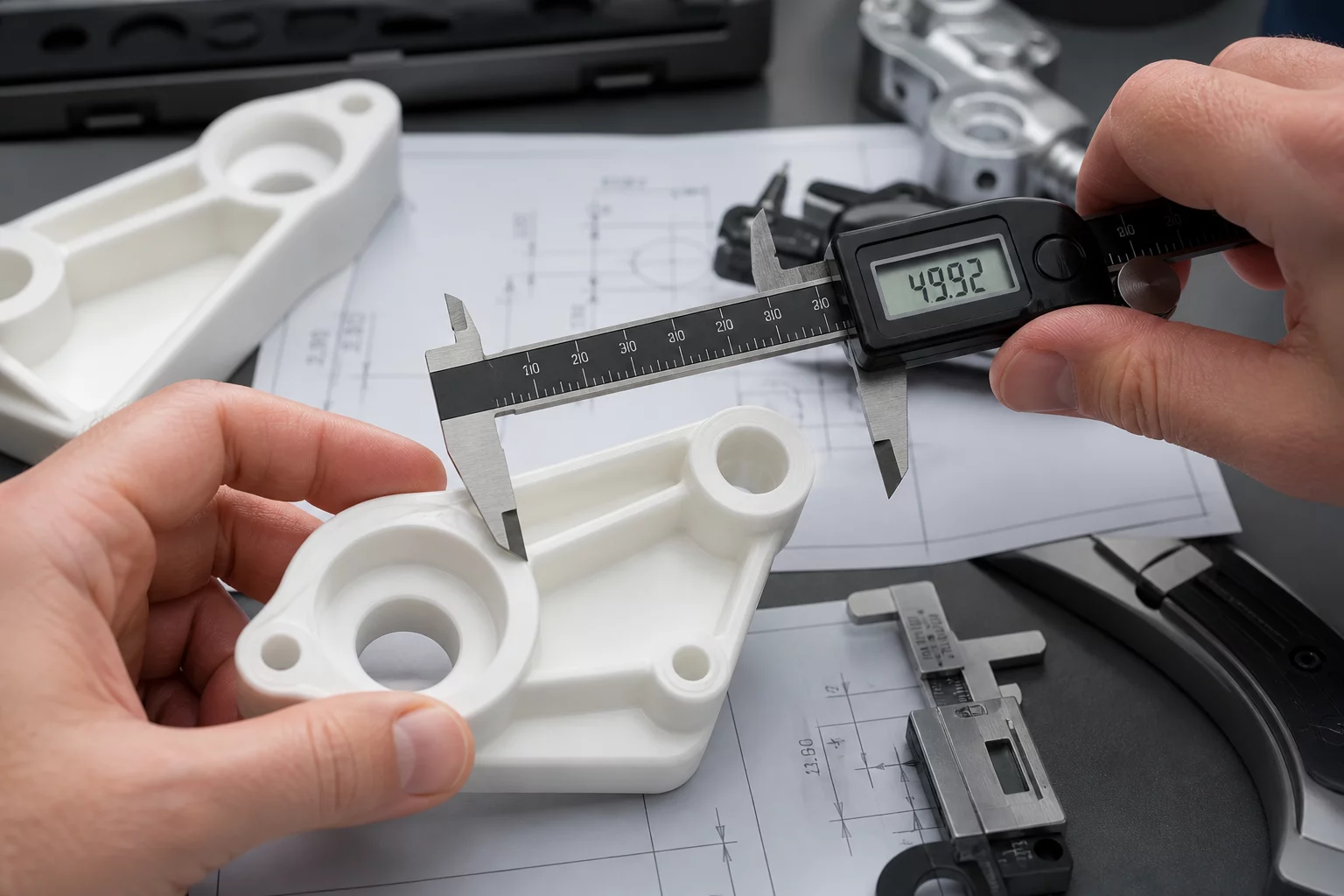
Surface Optical Note: Microscopic scan captured at 45° grazing angle illumination to accentuate 3D print surface defects, wall flow anomalies, and layer line micro-discontinuities across coordinate axes.
Initial Diagnostic Thesis
When fine-tuning Bambu Studio slicing profiles to achieve a pristine, mirror-like exterior sheen, aggressive cooling adjustments and altered perimeter overlap formulas eliminated visible layer lines. However, the modified thermal soak time provoked uneven internal polymer contraction, generating an undetected 0.35 mm inner hole constriction.
Phenomenon Characterization & Surface Inconsistency
Surface gloss and micro-texture regularity frequently serve as misleading proxies for structural and dimensional fidelity. When operators prioritize visual smoothness by decelerating outer perimeters while allowing high hotend melt temperatures, the prolonged nozzle dwell time softens adjacent internal solid perimeters.
In high-speed toolpaths generated for Bambu Studio workflows, the distinction between outer wall line width and internal hole perimeter compensation becomes acute. As the outer skin cures into a satin, defect-free appearance, molten plastic on the inner radii is pulled inward by surface tension before crystallization completes. Visual quality metrics pass quality control without flags, while mechanical bore tolerances fail instantly during pin gauge verification.
| Inspection Parameter | Baseline Spec | Observed Anomaly | Resolution Target |
|---|---|---|---|
| Internal Bore Diameter | 20.00 mm (±0.04) | 19.65 mm (-0.35 mm) | 20.02 mm Locked |
| Outer Wall Speed | 150 mm/s | 45 mm/s (Over-melted) | 95 mm/s Balanced |
| Hole XY Compensation | 0.00 mm | 0.00 mm Unadjusted | +0.18 mm Active |
| Outer Surface Ra | 4.2 µm | 1.1 µm (Deceptive) | 2.4 µm Calibrated |
Correlated Root Cause Analysis
Forensic inspection confirms that cosmetic optimizations caused localized thermal hysteresis across dissimilar wall thicknesses. By reducing outer wall speeds to create a uniform matte sheen, nozzle contact time tripled, causing internal perimeter hoops to experience hoop stress contraction while cooling without sufficient cooling duct airflow on the inner cavity.
- Thermal Inward Pull: Internal circular vectors underwent inward material migration during slow outer boundary passes.
- Outer/Inner Wall Ordering: Printing the outer perimeter first stabilized surface texture but stripped inner walls of structural back-pressure support.
- Slicer Flow Compensation Gap: The increased overlap percentage masked seam lines on the outer skin while overfilling the interior junction points.
Interactive Telemetry Drilldown
Inner wall speeds were matched directly to outer wall parameters at 80 mm/s to prevent thermal contraction skewing. Slicer X-Y Hole Compensation was updated to +0.18 mm, counteracting filament draw on internal contours.
Forensic Case Discussion & Review
Peer-reviewed metrology logs and verification records for this case.
Submit Telemetry Observation
DIAGNOSTIC NETWORK